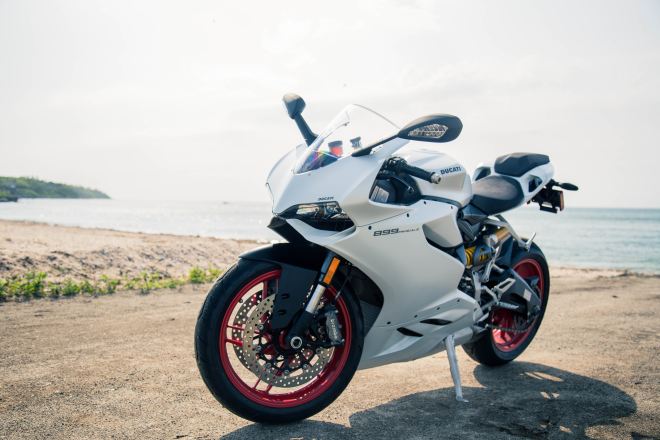
My motorcycle loving buddy and I were working on cars one Saturday morning when at some point he brought up motorcycles. He has been coaxing me to buy a my own bike for a time now, but I didn’t want to shell out the money just yet. He lists all the reasons why I should buy a motorcycle then my ears perked up when he told me:
Dude, it can save you money in the long run. I get about 50 miles to the gallon on my bike.
Being someone who loves to make smart investments, I got to thinking about how much I commute and if riding a more fuel-efficient vehicle would save me money. So I decided to really break down what it’ll cost to drive a car vs riding a motorcycle and see if investing in a mortocycle will be a money saver.
What to Consider Before Calculating
There are a number of variables I need to consider when doing this calculation. The biggest one being my location. Where I live will heavily influence just how much I can ride my motorcycle and how much gas will cost me for the bike.
I live in Minnesota, so any calculation done will be heavily dependent on this state.
How Often Will I Be Riding a Motorcycle?
Minnesota is infamous for its brutal winters that last 3/4 of the year. For us Minnesotans, winter doesn’t officially stop until the beginning of May and kicks up again shortly after September. So if I were to ride a motorcycle I only have roughly 5 months of the year to ride.
All other times of the year I need to be wary of snowfall and cold weather that’s going to coax me into not riding a bike. So for the rest of 7 months, I’ll need to rely on a car for commuting. Can’t just pick one or the other here.
How Much Will Gas Cost Me?
Say what you want about the cost of gas nowadays, but when I travel cross-country, I rarely see gas prices drop as low as they do in Minnesota
On average, the gas prices for Minnesota fluctuate year-round, going anywhere from $2.90 a gallon to as low as $2.00 a gallon. If I want to find a nice median point for these ranges I can point it at $2.45/gallon. This is the variable I’ll be using for my calculations.
The Cost of Driving a Car
So obviously, the miles per gallon(MPG) of your car is completely dependent on the type of car you have. It’s also influenced based on if you are taking on the road vs the highway.
I have a 2007 Honda Accord, which according to Fuel Economy equates to a combined 25 miles to the gallon. The car itself holds close to 12 gallons of gas. However, when I fill up my car I typically fill it when it’s close to 1.5 gallons from empty.
Let’s breakdown the variables here:
Car’s MPG: 25 miles/gallon
Average refill amount: 10.5 gallons
Times per month it’s refilled: 3 times
Doing the math on this, I can find that the total amount of miles per month I drive is:
25 mpg * 10.5 gallons * 3 times/month = 787.5 miles a month
Now if we want to calculate the average cost I pay per month we simply calculate it as:
$2.45 per gallon * 10.5 gallons * 3 times/month = $73.5 a month
Looking at my gas budget on Daily Budget these past 3 months it hits very close to this amount each month. Now let’s take these two amounts and see how much gas I’m paying per mile on my Accord.
$73.5 / 787.5 miles = $0.09333333(Round to $.09 per mile).
Cool, so now we have a number for how much money I pay each mile driving my Honda. Now how does this compare to a motorcycle?
The Cost of a Motorcycle
Since I do not have a motorcycle nor a motorcycle license, I am going to need to pay for additional expenses on my initial purchase. However, we will factor this in later after we get an fuel estimate.
I pulled in 3 motorcycle models to compare based on different recommendations given to me by my motorcycle enthusiast friends. I will be doing three different cost assessments with these bikes. The estimated miles per gallon number is pulled from the website Fuelly.
Since the amount of gallons for a bike varies, our formula will need to change a bit. Now instead of figuring out the total mileage, we want to figure out the number of times we’ll need to refill each month. These bikes hold anywhere between 4-6 gallons of gas apiece, so for the sake of calculation, let’s assume I fill it up 4 gallons each refill.
Our first formula then becomes:
787.5 / (mpg * 4) = times to refill/month.
So for example, if I had a bike with 40 mpg, it’ll be:
787.5 miles / (40 * 4) = 4.9 refills a month
We can then plug that number into the same second formula we used for calculating our average fuel cost per month to get the following measurements:

But wait! This does not factor a key variable we need to include per month. A new vehicle also means an increase in insurance. Consulting with my friends, I found that their average cost for motorcycle insurance is about $20/month.
So adding that $20/month per bike, our measurement is actually:

Well, it looks like the cost is still below that of a car, well that’s still good! Although, we still have to factor in three important costs that play into this: A motorcycle permit fee, motorcycle training classes, cost of a bike.
While the classes are not required to take the license test, every person I’ve spoken to about it says they strongly advise taking the classes before getting your license. So, I’m going to factor it in:
- Permit Fee: $21
- Classes: $195.00
- Cost of Bike: ???
Again, the cost of a bike is dependent on what you get. So I’m going to just take the average of what I found online for the three previously mentioned bikes and factor them accordingly:
- 2008 Honda CB600RR: $5,000
- 2009 Dual Sport Yamaha XT250: $4,000
- 2012 Yamaha Zuma 125CC: $2,000
So cool, we are looking at this as:
$21 + $195 + X Cost of Bike = Total Fixed Cost
Then we want to add in that total cost to our monthly cost which gives us the formula:
Total Fixed Cost + (Monthly Cost * Number of months) = Overall Vehicle Cost
So Is It Cheaper To Get a Motorcycle over a Car?
As we saw earlier, the cost of riding a motorcycle for 5 months out of the year will save us more money on gas than a car. But if we factor in the initial cost of a motorcycle, we find that a pretty hefty investment needs to be made first.
However, since the exponential cost of gas/month is still cheaper, and the total fixed cost remains constant, we can expect that at some point the bike will be overall cheaper than the car. The question is now, when?
Well, let’s plug in our numbers into the Overall Vehicle Cost formula for all 4 vehicles to see:
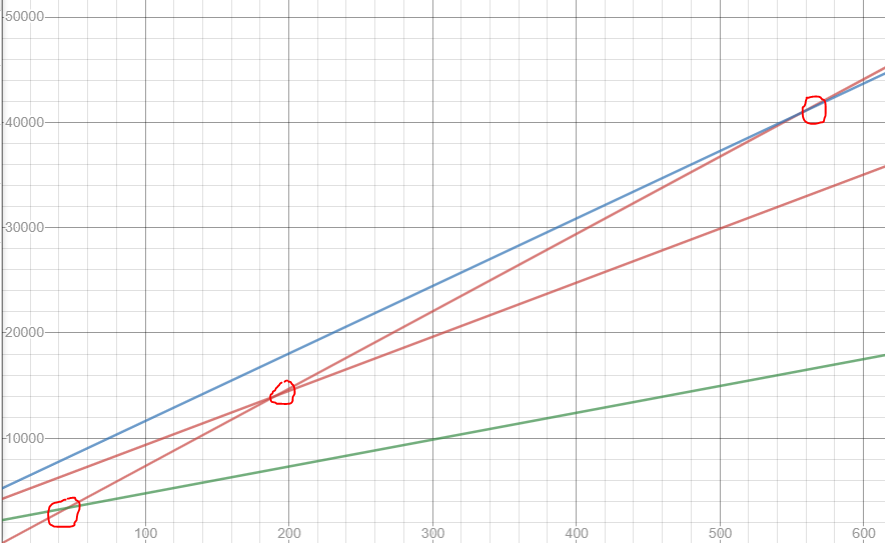
The Y-Axis on this graph is the total cost, while the X-Axis is the number of months.
- Pink: 2007 Honda Accord
- Blue: 2008 Honda CBR600RR – Cost-Effective after 555 months
- Red: 2009 Yamaha Dual Sport – Cost-Effective after 191 months
- Green: 2012 Yamaha Zuma 125CC – Cost-Effective after 46 months
So if take into consideration that we are only riding each bike 5 months out of the year, we really find each vehicle is cost-effective after:
- Blue: 2008 Honda CBR600RR – Cost-Effective after 111 years
- Red: 2009 Yamaha Dual Sport – Cost-Effective after 38.2 years
- Green: 2012 Yamaha Zuma 125CC – Cost-Effective after 9.2 years
Conclusion
So if each of these vehicles even managed to last until their cost-effective point with little to no maintenance, and I ride every single day I commute in those 5 months. At minimum, I have to ride it for a decade for it to be cost-effective.
This is also assuming:
- All costs like insurance and gas stay the same throughout these years
- I only pay for insurance after 5 years
- I have a free storage place for the vehicle during the colder months
All of these factors will influence cost, making it take a much longer time for these vehicles to be cost-effective.
So to conclude, if you don’t have to worry about any of the fixed costs and have a short-term motorcycle insurance plan, then riding one in the summer is definitely a cost-effective strategy compared to most cars. However, if you are planning on buying a motorcycle to save money in the long run, you are going to find yourself in a bad investment.
If you are interested in reading more articles on finances click on the Follow Button below to get the latest updates.
 Prometheus Quest